Decision guide
Which layer solves which problem
| Symptom | Right layer | Why |
|---|---|---|
| Calendars slipped on a busy weekend | Channel sync in a PMS | Only an inventory engine can close availability everywhere at once. |
| Same ten questions every week | Guest information layer | Repetition comes from scattered facts, not from missing software. |
| Owner asking where the money went | PMS with statements | Reporting obligations need per-property revenue and cost breakdowns. |
| Turnovers you cannot see | Task assignment and acceptance | An assigned task without acceptance is not covered. |
| Commission eating the margin | Owned direct channel | Commission falls only on bookings a channel you own brings in. |
The word covers more than most hosts need
Vendors use "property management system" for products that overlap only partly. Some are channel managers with a booking calendar attached. Some are accounting platforms with a guest inbox bolted on. Some are full operational systems built for agencies with dozens of units and owner reporting obligations. Comparing feature lists across those three categories produces a shortlist that answers no question you actually have.
A more useful starting point is a month of your own friction. Write down every incident: a double booking, a stale door code sent to a guest, an unconfirmed clean, a repeated question, a payment chased by hand, a report rebuilt from scratch. Next to each, write what it cost you in minutes, money or a review. That log is your requirements document, and it usually points at one area rather than three.
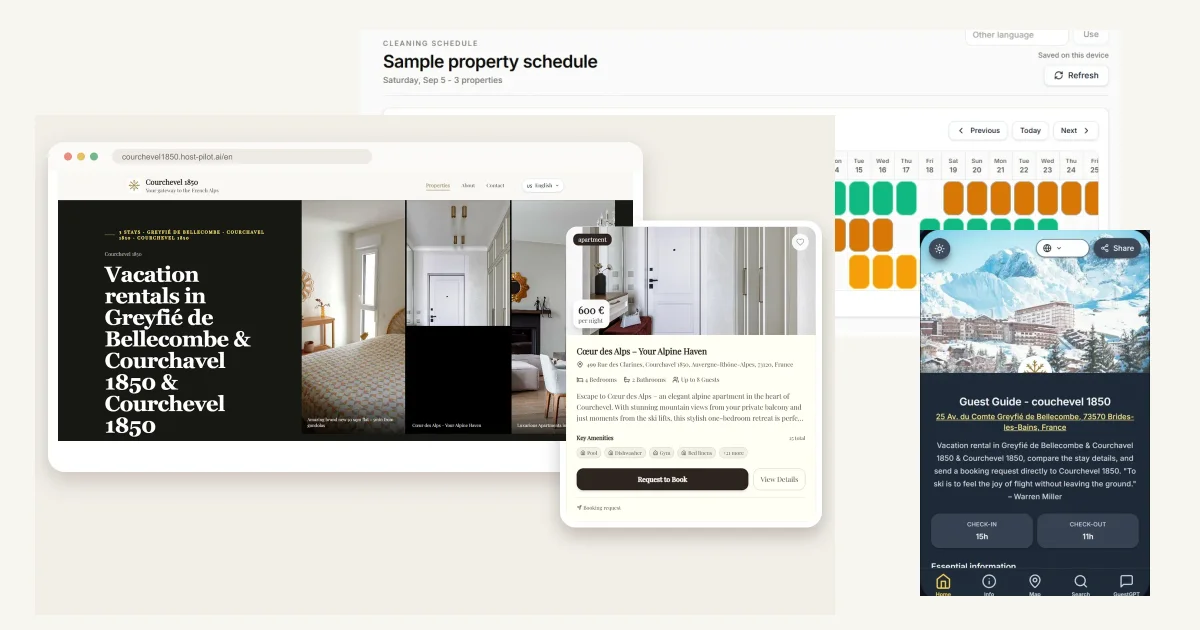
This page is written for an independent host with one to ten properties, not a management company. At that scale the two costs that dominate are the fifteen to twenty percent commission taken by Booking.com or the host-fee version of Airbnb, and the hours spent answering the same ten questions. Host Pilot addresses both from one place: paste your Airbnb or Booking.com listing URL and it builds a direct booking website, a mobile guest guide and connected guest messaging from the same verified source. It is not a PMS and does not pretend to be one.
Sort your problems into three jobs
Almost everything a host struggles with belongs to one of three jobs. The first governs inventory and money: cross-channel availability, rates, payments, deposits, payouts, owner statements, tax records. The second coordinates people: cleaning, maintenance, key handovers, confirmations. The third organises what the guest reads: the listing, the guide, the direct site and the messages that point to both.
A PMS is built for the first job and usually helps with the second. It does very little for the third, which is where most one-to-ten-property hosts are actually losing hours. Knowing which job your log points at is the single most valuable thing you can do before opening a comparison page.
- Inventory and money
- People and tasks
- Guest-facing information
- Cost per incident
The signals that genuinely mean "you need a PMS"
There are a few honest triggers. You sell the same unit on three or more channels and the calendar has slipped at least once. You owe someone else a statement — an owner, a partner, a co-host — with money broken out per property. You run cleaning shifts across several people and cannot see at a glance which turnovers are covered. You need tax-ready records that a spreadsheet is no longer producing without pain.
If none of those are true, a PMS will mostly add a monthly bill and a configuration burden. Two properties on one channel with a shared cleaner does not need an inventory engine; it needs one reliable place for facts and a message sequence that fires on booking state.
Channel sync is the function that must not fail
Once you sell on more than one platform, calendar sync stops being a feature and becomes the thing everything else rests on. Test it with a real booking in both directions and time how long the other calendars take to close. A short, known delay can be managed with a buffer; a variable and invisible one cannot.
Understand what your connection actually is. A one-way iCal import refreshes on the provider's schedule and can be slow enough to allow a double booking on a busy weekend. A native API connection is usually faster and can push rates as well as availability. Ask which one you are getting per channel, not in general.
One publisher, always
Whatever combination you end up with, exactly one system should write rates and availability. Two tools pointed at the same calendar will produce prices nobody chose and blocks nobody made, and the mistake usually surfaces while a guest is already travelling.
Write down who publishes, who approves changes and how you roll back. This is a five-line document that prevents the most expensive category of error in the whole stack, and it costs nothing.
Payments, deposits and what the platform still holds
If you take direct bookings, decide how money moves before you launch: when the card is charged, what happens on a change, how refunds are issued, whether you hold a deposit and under what written terms. A PMS may route this through a payment provider, which means a second set of fees and a second account to reconcile.
Keep platform bookings on the platform's payment rails. Their protection and dispute process depends on the transaction living there, and moving a confirmed platform booking off-platform is against Airbnb's policy as well as commercially risky for you.
Cleaning and team coordination without oversharing
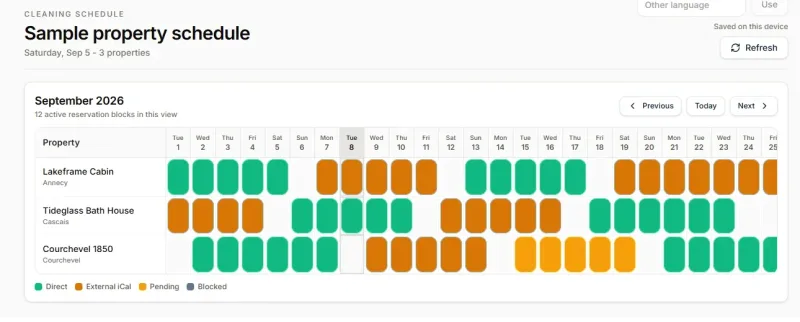
Every departure should become a task with a time window, access instructions, notes and an explicit acceptance. A task that is assigned but not accepted is not covered. Set the hour at which the backup plan starts, and what it is: offer to a substitute, shift the check-in, or block the night.
Share the schedule, the access method and the standard — never the guest's contact details or the amount paid. Forwarding a booking screenshot into a group chat is the common shortcut and the common leak. Plan how access is removed when someone leaves the team.
Owner statements and reporting, if you owe them
If you manage for someone else, reporting is often the real reason to adopt a system. Clarity beats completeness: occupancy, revenue, the main costs, incidents and what you did about them, on one page a person can read without a call.
State the assumptions. Which period, what each cost line includes, what is estimated. An owner who understands how a number was produced argues far less than one handed a confident figure with no method attached.
What a PMS will not fix
It will not make your guest information correct. Importing a listing does not know whether the gate code changed last month, whether the parking height limit is real, or whether the bin day moved. Every system inherits whatever you feed it, and a confident system repeating a wrong fact is worse than a note in your phone.
It will not reduce commission either. Commission falls only on the bookings that arrive through a channel you own, which is a slow, compounding asset rather than a switch. That is a separate project from inventory control, and it is usually the one with the better return at this scale.
Fix the information layer first
Decide which facts matter — access, wifi, appliances, parking with its real constraints, bins, rules, emergency contacts — and decide where the official version lives. If the same fact exists in the listing, four templates and your memory, two of them will be wrong within a season and a guest will be the one to find out.
This is the layer Host Pilot covers. Pasting the listing URL produces the direct site, the guide and the messages from one source, so a correction lands in all three at once. Sequence matters: correct the facts first, then automate the repetition, and only then take on inventory and accounting if the log says you must.
Count the total cost, including your hours
Add the subscription, any per-booking commission, per-unit pricing, add-on modules, payment fees and your own setup and maintenance time. A cheap plan with a booking commission can overtake an expensive flat fee as volume grows, and the reverse is true if you run a few long stays.
Ask before you sign what you can export, in what format, and what stays reachable if you stop paying. Content, guides and links must survive a provider change; otherwise the cost of switching lands on a guest who finds a dead page. Read the pricing alongside that question, not instead of it.
Trial with real events, not a demo dataset
Set up one real property and push the same events through each candidate: a new booking, a date change, a cancellation close to arrival, an out-of-policy request, and a same-day booking. Count the manual steps each one needs and note whether the system warns you when something is inconsistent.
Then judge maintenance rather than setup. Who updates content when a code changes? Who notices when an automation stops firing? The right choice is the one your team will actually keep current in the busiest week of the year, not the one that demos best on a quiet Tuesday.
Worked example
Three properties, one wrong diagnosis
A realistic illustration rather than a customer story. A host with three flats on Airbnb and Booking.com spends a weekend comparing property management systems after a near double-booking. The month-long friction log tells a different story: one calendar incident, four unconfirmed cleans, and thirty-one repeated guest questions about parking, bins and the wifi password.
The calendar issue is real and worth a two-way connection with a buffer. But the thirty-one questions are the actual cost, and no inventory engine removes them. Fixing the source of those facts once, and pointing every message at it, returns more hours in the first month than the PMS would in six — and it leaves the door open to adopt one later, when a fourth channel or an owner statement genuinely requires it.
Practical workflow
How to decide in seven steps
- 1
Log a month of friction
Every incident with its cost in minutes, money or a review.
- 2
Sort into three jobs
Inventory and money, people and tasks, or guest-facing information.
- 3
Check the PMS triggers
Three-plus channels, owner statements, cleaning shifts, tax-ready records.
- 4
Fix the facts first
One official version of every durable detail before automating anything.
- 5
Name one publisher
Exactly one system writes rates and availability across channels.
- 6
Trial with real events
Booking, change, late cancellation, out-of-policy request, same-day arrival.
- 7
Price the whole thing
Fees, modules, payment costs, your hours and the exit path.
Property management system FAQs
Do I need a PMS for two or three properties?
Usually not. A PMS earns its cost when inventory and money break: three or more channels, owner statements, cleaning shifts across several people, or tax records a spreadsheet no longer produces cleanly. Below that, the information layer is the cheaper win.
What is the difference between a PMS and a channel manager?
A channel manager keeps availability and rates aligned across platforms. A PMS usually includes that plus payments, tasks, owner statements and reporting. Many products blur the line, so ask what it does per job rather than accepting the label.
Will a PMS reduce my commission?
No. Commission falls only on bookings that arrive through a channel you own, such as a direct site or repeat guests. That is a separate project, and it grows slowly rather than switching on.
Can I run a PMS and a separate guest-facing layer?
Yes, and many experienced hosts do: a PMS for inventory and money, a lighter layer for the guide, the direct site and messaging. The rule that matters is that only one system writes rates and availability.
How do I test channel sync properly?
Make a real booking on one channel and time how long the others take to close, then repeat with a cancellation. Read a settings screen last, not first. Add a buffer if the delay is longer than a few minutes.
What should I check before I sign?
What you can export, in what format, and what stays reachable after you stop paying. Content, guides and links must survive a provider change so a guest never lands on a dead page.
Useful next steps
Keep exploring
Start with one reviewed listing
The word covers more than most hosts need
A property management system exists to control inventory and money: availability synced across channels, rates, payments, owner statements, cleaning shifts and reports. It earns its cost when that side of your operation is what breaks. With one to ten properties the thing that usually breaks first is information — the same facts living in a listing, four message templates and your head — and that is a smaller, cheaper problem to solve. Diagnose the bottleneck before you buy, because buying for the wrong job feels like progress while the real cost keeps running.