Decision guide
Choose the website scope
| Need | Approach | Why |
|---|---|---|
| One property and referrals | Focused property site and verified request | Low maintenance and clear status |
| Instant booking | Calendar and payment engine | Availability and agreement must be reliable |
| Several properties | Portfolio navigation plus property pages | Visitors need the right unit without duplicated copy |
| Complex distribution | PMS and channel manager integration | Inventory needs a central owner |
| Stay support | Connected mobile guest guide | Durable answers should not live in old messages |
What makes a vacation rental website useful
A useful website reflects the real stay. It explains capacity, sleeping arrangements, location context, amenities, limitations, price and policies without forcing the visitor to open a chat. The first goal is clarity, not decoration or an arbitrary amount of text.
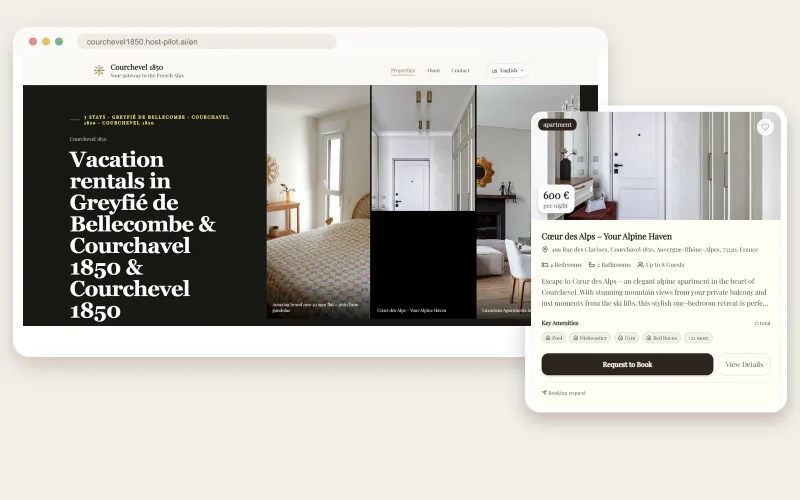
Host Pilot can use an Airbnb or Booking.com listing as a starting point for a direct website and digital guest guide. Importing saves setup work, but the host still approves photos, facts, rules, calendar and sensitive information before publishing.
A vacation rental website starts with verified property facts
Audit every imported fact against the current property. Confirm beds, capacity, amenities, check-in window, parking and material accessibility limits. Remove platform-specific language that does not make sense on an owned site.
Sequence photographs so a visitor can understand arrival, shared space, bedrooms, bathrooms and important amenities. Use current WebP images with stable dimensions and descriptive alt text.
- Current property facts
- Logical image sequence
- Visible limitations
- No sensitive access details on public pages
Design the decision path before the visual polish
The visitor should find suitability, dates, total price, conditions and next step quickly on mobile. A large hero cannot compensate for hidden booking status or an unclear form. Use headings that answer real questions and keep commands visually distinct.
Accessibility supports every visitor: labelled fields, visible focus, useful errors, sufficient contrast and controls that work without a mouse. Test the longest translated labels so localizations do not overlap or truncate.
Treat calendar and confirmation as operational systems
A request, provisional hold and confirmed booking are different states. Name them accurately. Choose one authoritative calendar and test how platform bookings, changes and cancellations reach the website.
A confirmation should repeat property, dates, party size, price, policy, status and contact. If payment or approval is pending, make the next action and deadline explicit.
Build trust with evidence you actually possess
Use an identifiable business or host, a real contact method, policies and sourced reviews where permitted. Do not invent customer counts, ratings, revenue gains, commission savings or Google outcomes.
Domain ownership, working links, consistent language and accurate photographs are stronger trust signals than unsupported badges. Test from an unsigned mobile browser and a slow connection.
Connect website content to the stay
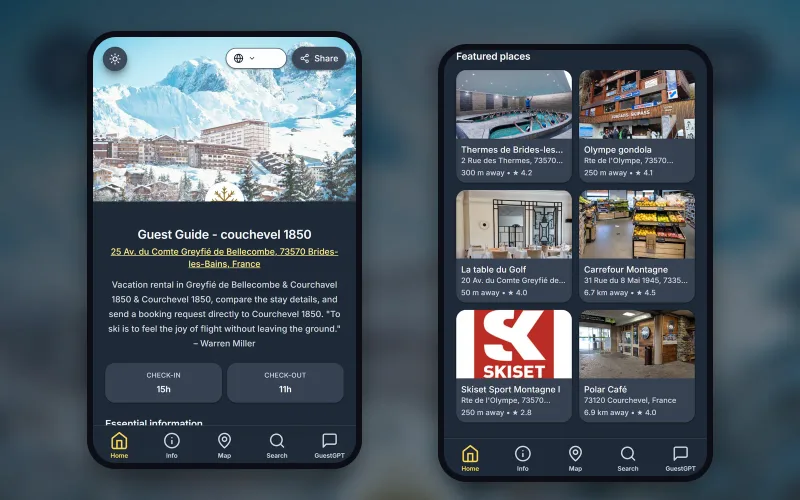
The website helps a visitor decide; the guest guide helps a confirmed guest complete the stay. Keep Wi-Fi, appliances, house rules and local recommendations in the guide, shared by link or QR. Messages should point to the guide rather than duplicating durable facts.
GuestGPT can retrieve approved guide answers. It should escalate emergencies, refunds and uncertain access. The value is faster discovery of verified information, not a claim that AI replaces hospitality.
Measure acquisition in the right order
Measure indexation before impressions, impressions before visits, and visits before enquiries and confirmed bookings. A page can be technically valid and still have limited demand. Search engines do not owe a ranking because a page is long or uses schema.
When a stage is weak, repair that stage. No indexation calls for a technical and originality audit; impressions without clicks call for snippet and intent review; visits without action call for clarity, trust, price and availability review.
Realistic example, not a testimonial
A website receives visits but no enquiries
A property page receives referral visits, but the price is hidden until a long form is completed and the calendar looks instantly bookable even though every request needs approval. Visitors leave because the status and commitment are unclear.
The host changes the page to show the expected total, label the request correctly and explain the reply time. The lesson is diagnostic: improve the missing decision information rather than adding unsupported claims or more generic copy.
Practical workflow
Build a vacation rental website in six steps
- 1
Verify the property
Confirm facts, images, amenities, limitations and policies.
- 2
Map the visitor questions
Answer fit, dates, price, terms, trust and next action.
- 3
Define booking states
Separate request, hold, payment and confirmation.
- 4
Test the calendar
Verify bookings, changes, cancellations and failure handling.
- 5
Connect the guest guide
Move durable stay information into one reviewed mobile source.
- 6
Measure the funnel
Track indexation, visibility, visits, enquiries and bookings separately.
Vacation rental website FAQ
What should a vacation rental website include?
Verified property content, current images, availability or request status, total price, policies, host identity, contact and a clear confirmation path.
Will a website automatically rank in Google?
No. Technical eligibility, original usefulness, demand, internal links and wider site authority all influence search visibility.
Can I create it from an Airbnb listing?
Yes. Host Pilot can use a listing URL as a starting point, but the host must review imported facts and remove platform-specific or sensitive information.
Do I need online payment?
Not always. A request flow can be appropriate if status and reply time are clear. Instant booking requires reliable availability and secure payment.
How is a guest guide different?
The website helps a visitor choose and book; the guide helps a confirmed guest arrive and use the property.
When do I need a PMS?
A PMS is more appropriate when inventory, channels, owner reporting, accounting, payment or permissions are the main operational problem.
Useful next steps
Build a reliable guest journey
Start with one reviewed listing
What makes a vacation rental website useful
A vacation rental website should help a visitor understand the property, decide whether it fits, see a safe booking path and know what happens next. It can support direct relationships and repeat demand, but it does not guarantee Google rankings, rich results, revenue or commission savings. Strong foundations are accurate property content, a reliable calendar, transparent terms, mobile usability and an operating process the host can maintain.