A weekly operating review for short-term rentals
Rental business insights that lead to a clear next action
Rental business insights are useful when they connect a trustworthy signal to a decision. Review booking pace, sellable-night occupancy, average daily rate, revenue per available night, net contribution, guest questions and operating incidents together. Then record one action, its owner and the date you will check the result. A dashboard should shorten that review, not replace judgment.
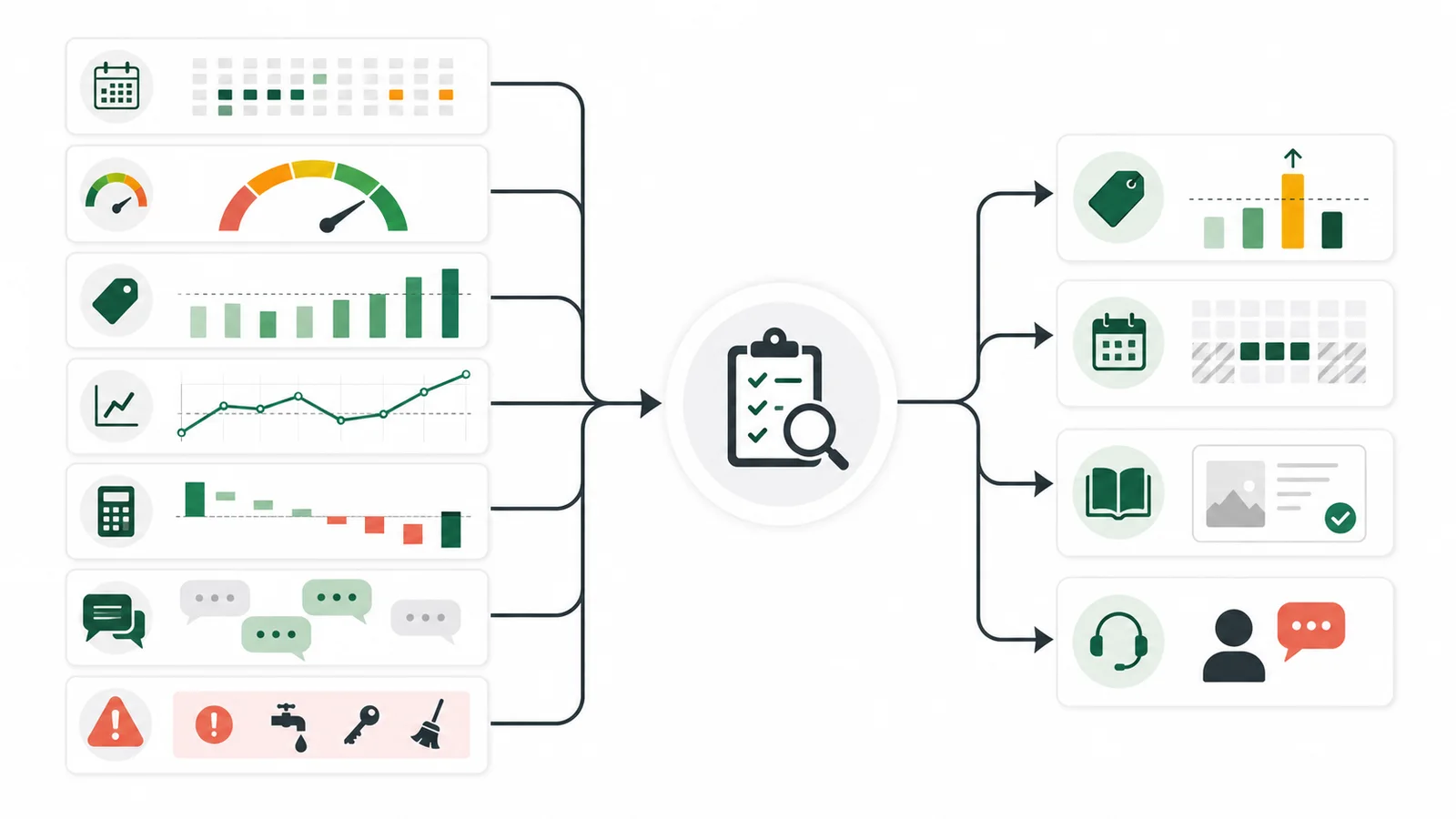
What should I review this week?
Start with exceptions, then economics, then guest friction. These four checks are enough to reveal most urgent work for a small portfolio.
Gaps and risks
Check unbookable gaps, stale availability, cancellations and arrivals without a confirmed handoff.
Booking pace
Compare future booked nights with the same lead-time checkpoint, not with last month’s final occupancy.
Net contribution
Read accommodation revenue after channel, payment, turnover and stay-level variable costs.
Repeated friction
Group repeated questions and incidents by confirmation, arrival, stay and departure.
The rental business insights worth keeping
A metric earns space only when you know what it measures, which denominator it uses and what decision it may change. Benchmarks are context, not universal targets.
| Metric | Transparent formula | How to read it | Possible action |
|---|---|---|---|
| Booking pace | Future booked nights at a fixed lead time | Compare equivalent stay dates and booking horizons. | Review availability, restrictions and rate only where pace has changed. |
| Sellable-night occupancy | Booked nights ÷ nights actually offered | Exclude owner stays and maintenance blocks from the denominator. | Investigate empty sellable nights without treating a full calendar as proof of profit. |
| Average daily rate (ADR) | Accommodation revenue ÷ booked nights | Keep cleaning, taxes and pass-through fees out of accommodation revenue. | Read ADR with occupancy, stay length and contribution before changing price. |
| Revenue per available night | Accommodation revenue ÷ sellable nights | Combines rate and occupancy for the same period. | Use it to compare periods, then diagnose price, restrictions and demand separately. |
| Net contribution | Stay revenue − stay-level variable costs | Include channel or payment fees, turnover and consumables. | Set a defensible floor or minimum stay for costly short bookings. |
| Lead time and stay length | Days to arrival; nights per booking | Segment by season and channel instead of averaging everything. | Adjust timing, minimum stays or gap rules for a specific horizon. |
| Guest and operating friction | Repeated questions and incidents per stay | Classify the source: missing content, timing, handoff or equipment. | Correct the guide, message, ownership or physical check that caused it. |
Worked example — not a customer result
An 80% occupied month can still hide a weak decision
A property offered 25 sellable nights, booked 20 and earned 3,200 in accommodation revenue. Its occupancy was 80%, ADR was 160 and revenue per available night was 128.
Five two-night stays required five turnovers. After channel or payment fees, cleaning not fully passed through and consumables, the host found that two short stays contributed less than expected. The useful insight was not “raise occupancy.” It was to review the short-stay floor and the gaps that allowed expensive turnovers.
The same occupancy can produce a different result when rate, stay length, channel cost and turnover burden change.
Turn each signal into a decision
Write the diagnostic before choosing the intervention. A weak number does not automatically mean “discount.”
| Signal | Check first | Useful next action |
|---|---|---|
| Slow near-term pace | Are dates visible, sellable and compatible with minimum-stay rules? | Repair bookability before testing a targeted rate change. |
| High occupancy, weak contribution | Stay length, turnover burden and channel cost | Review the floor, short-stay rules or fee presentation. |
| Repeated arrival questions | Guide clarity, message timing and link visibility | Correct one durable source before sending more messages. |
| Upcoming stay at risk | Payment, cleaning, access and current reservation status | Assign a person and stop uncertain automation. |
| Direct traffic without bookings | Availability, total price, trust, mobile usability and checkout path | Fix the first verified point of friction and measure again. |
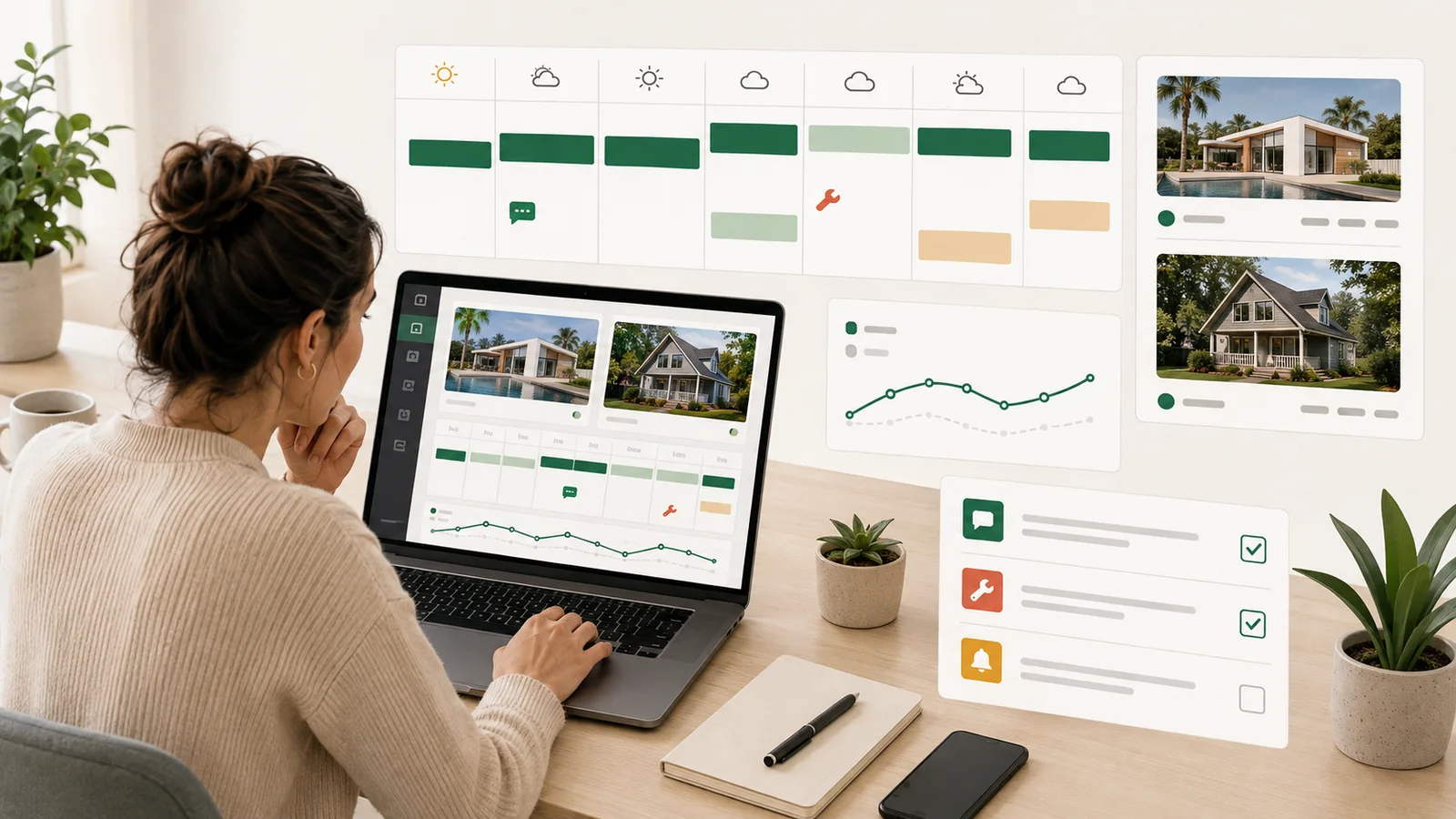
How Host Pilot turns available signals into actions
Host Pilot works from information already present in the account. It does not claim to see every market, accounting or channel signal.
- 1
Bring the property into one workspace
Import a listing, review property facts and keep the public information accurate.
- 2
Read reservation and calendar context
Use upcoming stays, booked dates, availability and current property rates as operating context.
- 3
Surface priorities
Dashboard insights can organize available metrics and exceptions into suggested actions. Limited data should remain visibly limited.
- 4
Correct the guest-facing source
A reviewed property can support the direct website, digital guest guide and connected communication flow.
- 5
Keep the human decision
Pricing, refunds, safety, accounting, unusual access and uncertain recommendations remain host decisions.
A practical 20-minute weekly review
Use the same sequence and record only decisions. Looking at charts without choosing an owner or follow-up date is observation, not management.
- 1. Resolve arrivals, cancellations and operational exceptions in the next 14 days.
- 2. Compare booking pace at consistent horizons for the next 15–60 days.
- 3. Review ADR, sellable-night occupancy and revenue per available night together.
- 4. Check net contribution on unusual or short completed stays.
- 5. Group repeated guest questions and incidents by journey stage.
- 6. Choose no more than three actions and assign an owner.
- 7. Record the change, its reason and the next review date.
Choose the lightest system that owns the decision
The right setup depends on the problem, portfolio and cost of being wrong.
| Need | Good starting point | When to use more |
|---|---|---|
| One to a few properties and a weekly review | Spreadsheet plus channel reports | Add software when collection or handoffs stop being reliable. |
| Connected guest-facing actions | Host Pilot | Use it when one reviewed property should support the direct site, guide and communication. |
| Complex distribution, owners or finance | Full PMS or specialist platform | Use deeper controls for accounting, permissions, channel APIs and portfolio reporting. |
Rental business insights FAQ
Which rental business insights should a small host track?
Start with booking pace, sellable-night occupancy, ADR, revenue per available night, net contribution, lead time, stay length, repeated guest questions and operating incidents.
Is occupancy enough to judge a vacation rental?
No. Read occupancy with rate, available-night definitions, stay length, channel costs and turnover costs. A full calendar can still contain weak stays.
How often should I review rental performance?
A concise weekly review works for operating decisions. Use equivalent booking horizons, then perform a deeper monthly reconciliation with complete financial records.
What is the difference between ADR and revenue per available night?
ADR divides accommodation revenue by booked nights. Revenue per available night divides it by sellable nights, so it reflects both achieved rate and occupancy.
Can Host Pilot replace accounting or a PMS?
No. Host Pilot connects direct booking, a digital guest guide and communication around reviewed property information. Accounting and complex portfolio controls may need specialist systems.
How should I use market benchmarks?
Use dated, comparable market data as context only. Your property’s costs, availability, quality, restrictions and historical pace remain the better operating baseline.
Can AI prove what caused a booking change?
No. AI can summarize available signals and suggest checks, but attribution requires controlled changes, reliable data and human review.
Review one property before adding another dashboard
Start from the property information and booking context you already have. Keep the useful signal, choose one action and record when you will review it.
Start with one listing