Decision guide
Match software to the rental responsibility
| Primary responsibility | Likely category | Verification |
|---|---|---|
| Short-stay reservations | Vacation-rental PMS or channel manager | Test changes and cancellations |
| Long-term leases and rent | Tenancy property-management platform | Verify local financial and document needs |
| Guest information | Digital guide and connected communication | Update one fact and confirm every guest view |
| Owner accounting | PMS or accounting workflow | Reconcile a representative statement |
| Direct guest journey | Owned website plus booking process | Verify calendar, total price and confirmation |
Define the rental model before comparing software
A product labelled rental property software may be designed for nightly reservations, annual leases or a mixed portfolio. Those workflows share property records but differ in money, contracts, communication and operational cadence. A short-stay guest journey cannot be managed responsibly with a tenant ledger alone, while a vacation-rental guide does not replace lease accounting.
Review the previous month and list failures: stale availability, repeated arrival questions, missed turnover acknowledgement, unclear payment state, owner-reporting work or maintenance requests without an owner. Assign each problem to its source and responsible person. This reveals whether the missing layer is a PMS, accounting system, maintenance tool or guest-experience workflow.
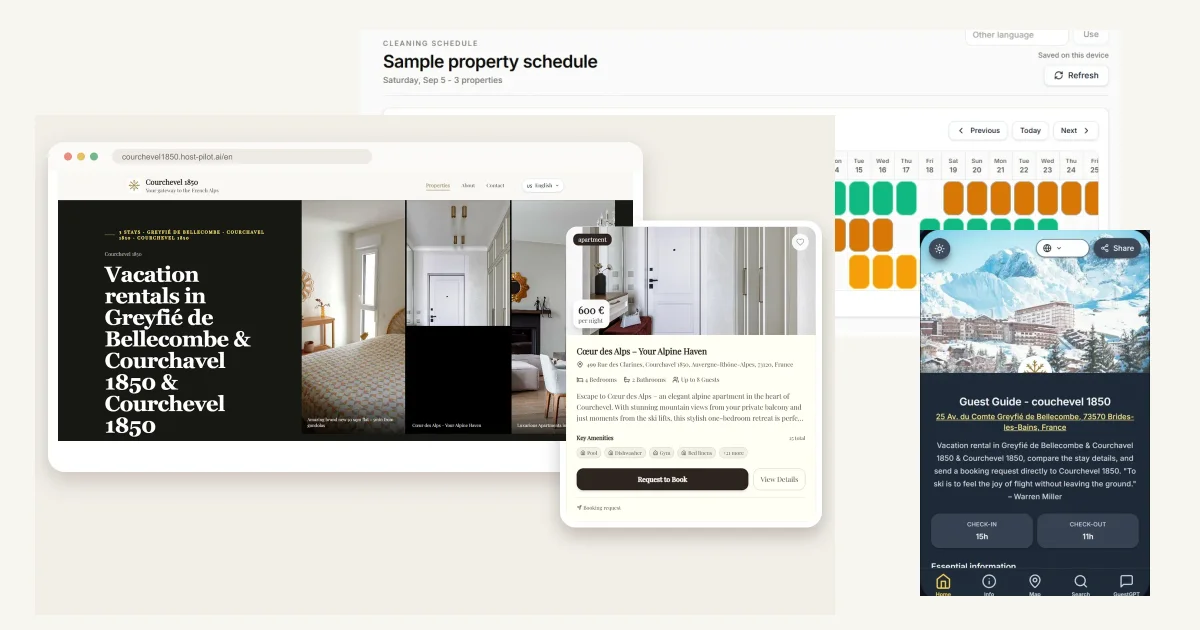
Host Pilot is designed for short-term-rental guest experience. It can create a direct booking website and digital guest guide from a listing and connect guest communication. It is not a long-term tenancy, rent-collection or owner-accounting platform.
Separate short-stay and long-term responsibilities
Short stays revolve around changing availability, reservations, arrival, turnover and repeated property questions. Long-term rentals revolve around applications, leases, recurring rent, deposits, inspections and tenant maintenance. Mixed portfolios often need separate specialist systems with a clear property identifier between them.
Write down the legal and financial records the operation must retain and confirm them with qualified local professionals. Software can support a process, but a generic page cannot determine the correct lease, tax or deposit treatment for every market.
- Rental model and stay length
- Reservation or lease ownership
- Payment and document obligations
- Maintenance and communication cadence
Map each workflow to one source of truth
Availability, rates, reservation status, property knowledge, tasks and financial records each need an authoritative source. Duplicating Wi-Fi instructions across templates or editing dates in several calendars creates conflicts that software cannot hide safely.
For each source, name who may edit it, how a change is verified and what happens when the integration fails. A replacement team member should be able to find the current state without searching personal messages.
Evaluate reservations and calendar behaviour
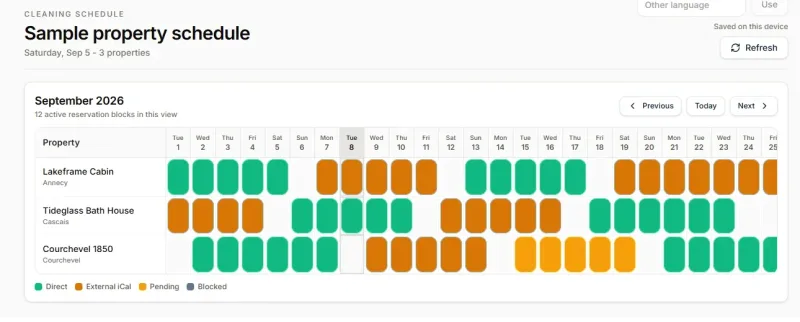
For nightly rentals, test booking, modification and cancellation across every selling channel. Measure update delays and verify the guest-visible result. If a delay can create a double booking, the operation may need a channel manager rather than a lighter calendar connection.
A request, provisional hold and confirmed booking are different states. The software and guest messages must describe them accurately, especially before payment or manual approval.
Test team handoffs and maintenance ownership
A sent task is not a completed turnover or repair. Require acknowledgement, a due time, evidence where appropriate and an escalation owner. Give contractors only the information they need and remove access when the relationship ends.
Use realistic failure cases: a cleaner declines, an appliance fails during a stay or a reservation changes after the task was created. The software should make the exception visible and support a human decision rather than silently continuing the original workflow.
Compare reporting with the decision it supports
A dashboard is useful when a metric leads to a defined action. For short stays, that may include booking pace, lead time, stay length, gaps, cancellations and repeated guest questions. For long-term rentals, the relevant measures and records are different.
Do not accept invented portfolio returns, tax savings or time reductions as product proof. Ask for the data source, calculation and applicability to your operation. Run a pilot and measure your own manual interventions, errors and recovery time.
Choose a guest-experience layer when that is the real gap
If the reservation and financial core already works, a full migration may be unnecessary. Host Pilot can use an existing Airbnb or Booking.com listing to start a direct website and mobile guest guide, then connect communication to the same reviewed information.
Choose a broader PMS when the difficult work is channel distribution, payments, contracts, owner statements, accounting or granular team permissions. The honest choice follows the responsibility that must be owned, not the product with the longest feature list.
Realistic example, not a testimonial
Three holiday rentals and one information problem
A host with three holiday apartments already has reliable platform calendars and payment records. Most daily work comes from copying arrival details, correcting old messages and answering the same parking and appliance questions. Replacing the booking system would not address the main bottleneck.
The host pilots a shared guest-information layer for one property and measures questions, corrections and recovery work. If the operation instead lacked owner statements or dependable channel inventory, the software decision would move toward a full PMS.
Practical workflow
Choose rental property software in six steps
- 1
Define the rental model
Separate short stays, long-term tenancies and mixed-portfolio responsibilities.
- 2
List recent failures
Use real calendar, payment, task, reporting and guest-information problems.
- 3
Name the sources
Assign availability, money, documents, property facts and tasks to authoritative systems.
- 4
Test exceptions
Run changes, cancellations, declined tasks and failed integrations.
- 5
Pilot one property
Measure manual intervention, errors, recovery and maintenance effort.
- 6
Choose by responsibility
Select a guest layer, PMS or tenancy platform according to the work it must own.
Rental property software FAQ
What is rental property software?
It supports some combination of property records, reservations or leases, payments, maintenance, communication and reporting. The category varies significantly by rental model.
Is vacation-rental software the same as landlord software?
No. Short stays emphasize reservations, availability, turnovers and guest journeys; long-term platforms emphasize leases, recurring rent and tenant operations.
What should a small short-stay host choose first?
Choose the tool that fixes the most costly current failure, such as calendar control, guest information or turnover ownership, then test it with one property.
Does software guarantee higher income?
No. Software can make a workflow more consistent, but demand, property quality, pricing, costs and execution determine financial results.
When is a full PMS necessary?
It becomes more relevant when channels, units, payments, owners, reporting or team permissions create complexity that a lighter layer cannot own.
What does Host Pilot cover?
Host Pilot focuses on a direct booking website, digital guest guide and connected communication generated from a short-term-rental listing.
Useful next steps
Plan the operating system
Start with one reviewed listing
Define the rental model before comparing software
Rental property software is a broad category, so the first decision is whether the operation manages short stays, long-term tenancies or both. Short-stay hosts usually need reservation, availability, turnover and guest-information workflows; long-term operators may need leases, rent collection, tenant maintenance and accounting. Choose the smallest system that owns the difficult responsibility clearly, and do not treat unsupported revenue or time-saving claims as evidence.