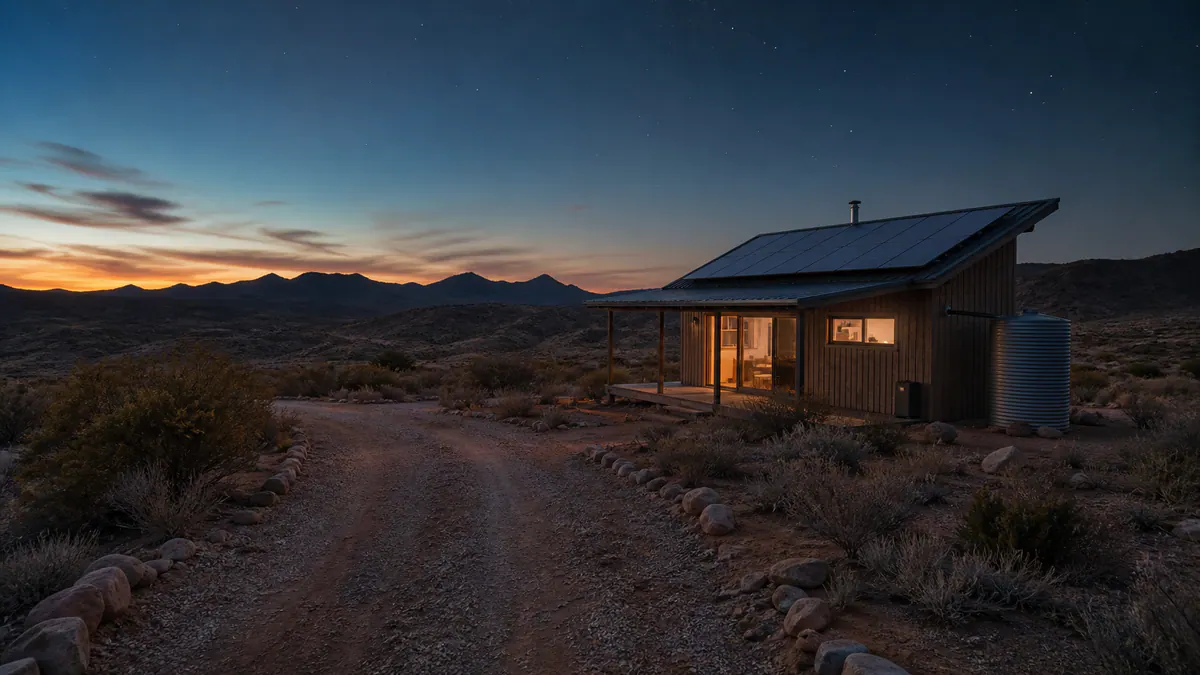
What does off-grid actually mean?
A property may generate solar electricity while using delivered water and a septic tank, or it may manage every service independently. Some keep a generator for backup. Ask which systems differ from a conventional home and what guest behavior protects them. “Eco” and “off-grid” are not interchangeable guarantees.
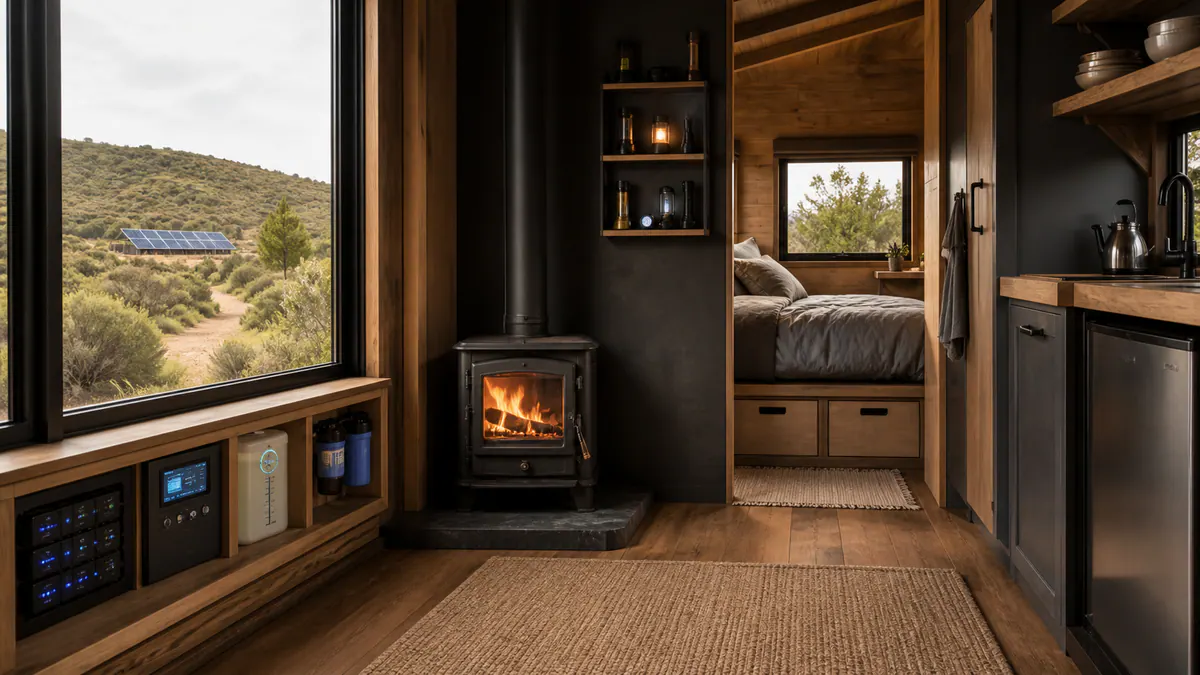
Good operators explain usable limits without making guests feel they are managing the property. A simple display can show battery level; clear labels can prevent the wrong material entering a composting toilet. Restrictions should be disclosed before booking, not discovered through warning notes after arrival.
Power, water and toilets need specific answers
Ask what runs simultaneously and which high-load devices are prohibited. Charging phones may be easy while hair dryers, heaters or vehicle charging are not. Water may be potable rainwater, a tested well or delivered supply; if it is not drinking water, the host should explain what is provided.
Toilets may be flushing, septic, composting or incinerating. Guests need a short operating explanation and handwashing facilities. Heating, cooling, refrigeration and hot water should be described separately because each may use a different fuel or system.
Remote access and emergency planning belong in the booking decision
Confirm the final road, vehicle clearance, gates, fuel distance and daylight-arrival recommendation. Mobile signal may disappear before the property, so save directions and a contact method offline. The National Park Service remote-trip safety page (opens in a new tab) is park-specific, but its preparation mindset—conditions, supplies and communications—illustrates why local official advice matters.
Themes below synthesize recurring decision points across the cited platform review research, current public category pages and publicly visible property material reviewed for this guide. They are not Host-Pilot reviews, ratings, testimonials, copied quotations or claims about every stay. Off-grid guests consistently praise silence, stars and a sense of self-sufficiency. Recurring negatives arise when power limits, toilet systems, rough roads or weak signal appear only after booking.
Responsible use without greenwashing
A small solar cabin can still create a long drive, construction impact and waste. Look for specific systems and practices instead of broad sustainability claims. Leave No Trace (opens in a new tab) offers general outdoor principles, but follow local fire, waste, wildlife and water rules supplied by the operator.
Editorial scenario: the battery at sunset
Cloudy weather has reduced solar input. The display is easy to read, refrigeration remains protected and the guest knows not to run several high-load appliances. There is a torch, backup heat and a clear contact path. This fictional scenario shows the difference between thoughtful independence and simply having fewer amenities.
What current research and traveler evidence add
Statistics retain their sample, geography and period. Review themes are synthesized decision patterns, not Host-Pilot ratings, testimonials or reproduced quotations.
Remote-rural interest: 86%
of Airbnb’s January 2026 US survey sample expressed interest in remote or rural stays; it does not measure off-grid bookings. source
Outdoor-impact framework: Seven principles
form Leave No Trace’s general responsible outdoor-recreation framework; local regulations remain authoritative. source
Darkness and quiet are the emotional reward
Across recent public off-grid reviews, star visibility, silence and separation from routine appear repeatedly as strengths.
Disclosed limits feel intentional; surprise limits feel like failure
Guests accept unusual toilets, power budgets and rough roads when they understand them before booking and receive concise instructions.
Compare off-grid service levels
| System | Light-touch independence | More demanding setup | What to verify |
|---|---|---|---|
| Power | Solar plus battery and backup | Small battery with strict load limits | Which devices can run together? |
| Water | Treated supply with normal taps | Carried or rationed water | Is it potable and how much is available? |
| Toilet | Familiar septic flush | Composting or incinerating | What instructions and restrictions apply? |
| Connectivity | Reliable Wi-Fi or mobile signal | Limited or no service | What emergency contact works? |
| Road access | Maintained all-weather track | High-clearance or seasonal route | Vehicle, daylight and weather requirements |
Off-grid booking checklist
- Ask which utilities are independent and how guests use them.
- Verify potable water, hot-water capacity and toilet type.
- Check heating, refrigeration and allowed electrical loads separately.
- Confirm final-road surface, vehicle needs, gates and fuel distance.
- Save directions, property contacts and local emergency information offline.
- Read fire, waste, wildlife and water rules before arrival.
Continue exploring
Frequently asked questions
Does off-grid mean there is no electricity?
No. Many properties use solar, batteries and backup generation. Ask what the system can reliably power.
Is water safe to drink at an off-grid rental?
It may be, but the source and treatment vary. The operator should explicitly state whether tap water is potable.
Will my phone work?
Coverage varies by location and network. Ask about current service and keep an offline arrival and emergency plan.
Are off-grid rentals environmentally friendly?
Not automatically. Evaluate specific energy, water, waste, construction and transport practices rather than the label.
When should I arrive at a remote rental?
Daylight is usually safer when roads, gates or paths are unfamiliar. Follow the operator’s local directions and weather advice.
Sources and further reading
Reviewed 2026-08-26. Sources support general category guidance; verify current property details, local conditions and booking terms directly.
- Airbnb’s 2026 most-wishlisted stays research Focaldata survey of 2,000 US adults plus Airbnb wishlist data; January 2026
- Airbnb’s 2026 tiny-home findings Australian traveler survey and Airbnb wishlist data; 2026
- Leave No Trace seven principles General responsible outdoor-recreation guidance; Current guidance reviewed August 2026
- National Park Service remote-trip safety guidance Park-specific remote travel guidance used as a planning example; Current guidance reviewed August 2026