What actually qualifies as a treehouse rental?
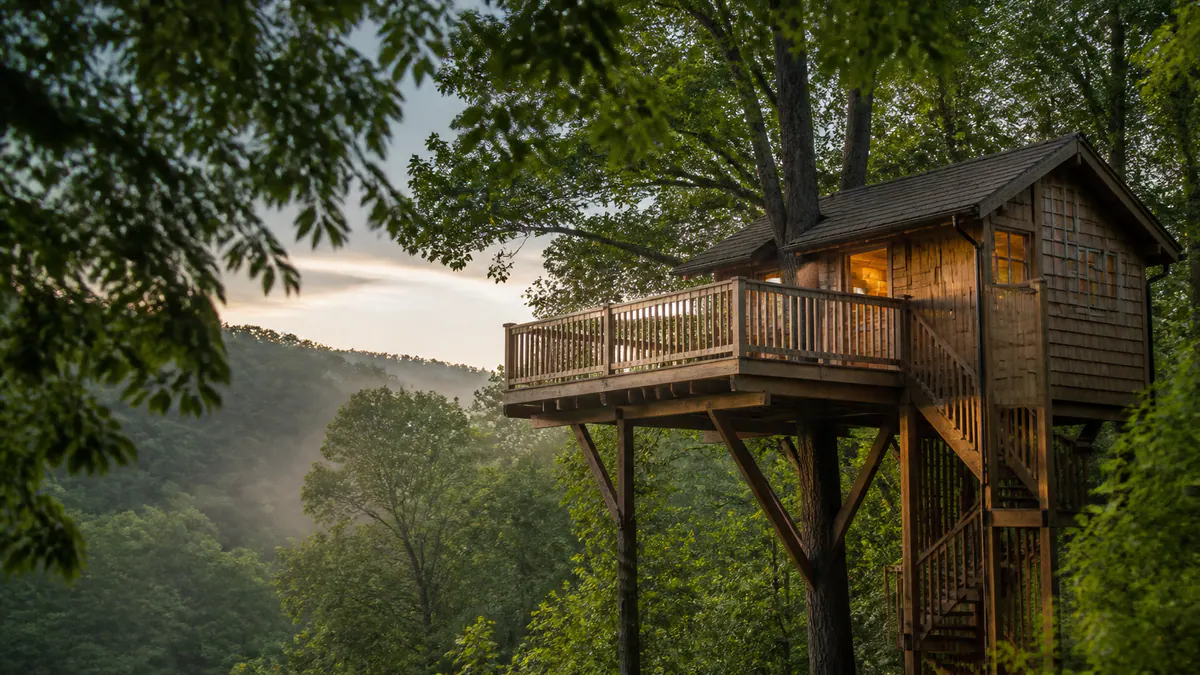
A useful treehouse definition is experiential rather than legal: the occupied space is elevated into or immediately among mature trees, and the canopy materially shapes the view, light or access. Some structures are supported by trunks; others stand on posts to protect the trees. A cabin with tree-print wallpaper is not the same experience.
Current listings in Airbnb’s treehouse collection (opens in a new tab) show the category’s range, from compact one-room retreats to family cabins linked by bridges. Treat those listings as examples, not a quality guarantee. Verify the specific structure, sleeping level and route from parking to door.
How height, access and weather change the stay
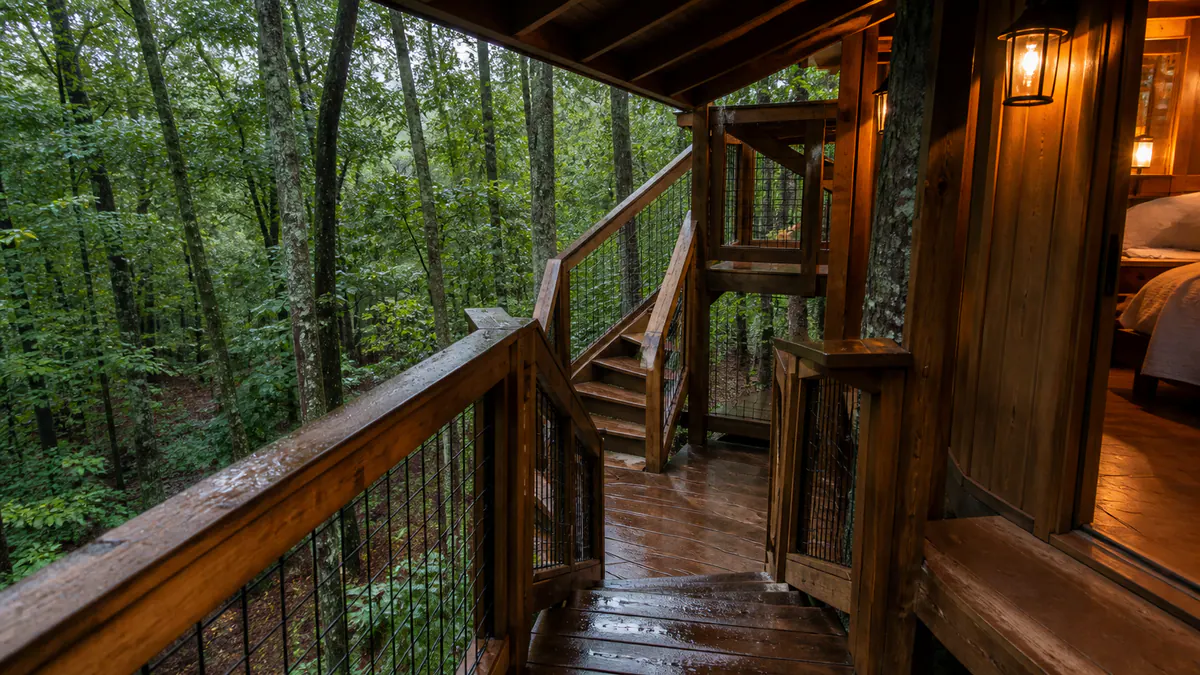
Count the steps and ask whether they are enclosed, illuminated and manageable with luggage. Loft ladders, suspension bridges and outdoor bathrooms may be delightful for one guest and impossible for another. Wind and rain are more audible at canopy height; branches shade rooms in summer but can make interiors darker and damp conditions more noticeable.
Heating, ventilation and insect screens deserve the same attention as the deck. In cold or wet seasons, confirm that the approach and stairs remain usable. If children are travelling, review barriers and sleeping arrangements with the operator rather than assuming “family friendly” answers every safety question.
Canopy immersion versus everyday comfort
The pleasure often comes from proximity: leaf movement outside glass, birds at eye level and a view that changes with the weather. Privacy depends on sightlines, not remoteness alone. Ask whether paths, neighbouring cabins or shared facilities overlook the deck and whether curtains cover the main sleeping area after dark.
Themes below synthesize recurring decision points across the cited platform review research, current public category pages and publicly visible property material reviewed for this guide. They are not Host-Pilot reviews, ratings, testimonials, copied quotations or claims about every stay. Treehouse guests consistently celebrate views, quiet and the feeling of being removed from routine. The recurring cautions are steep access, nighttime woodland sounds, temperature swings and smaller-than-expected bathrooms. None is automatically a flaw when described accurately.
Editorial scenario: arriving before the light disappears
A couple parks below the trees with one small bag each. They climb while the steps are still visible, learn the heater and find the bathroom before dusk. Later, wind moves through the branches above the roof. The point is practical: daylight arrival and light luggage turn unusual access into part of the pleasure. This is an editorial scenario, not a guest story.
What current research and traveler evidence add
Statistics retain their sample, geography and period. Review themes are synthesized decision patterns, not Host-Pilot ratings, testimonials or reproduced quotations.
Remote-stay interest: 86%
of 2,000 US adults in Airbnb-commissioned January 2026 research expressed interest in remote or rural stays; interest is not equivalent to a booking. source
Property-led destination choice: More than half
of the same US sample said a unique listing could inspire a destination they had not considered. source
Views and privacy deliver the emotional payoff
Across recent public treehouse reviews, elevated views, quiet decks and separation from everyday routines recur as the strongest positives.
Sounds and access need honest framing
Guests repeatedly mention wind, wildlife, steps and luggage. Clear descriptions turn these from surprises into informed tradeoffs.
Compare treehouse access and exposure
| Factor | Lower platform | Canopy-level room | Multi-level treehouse |
|---|---|---|---|
| Height | Gentle elevated feel | Strong canopy immersion | Dramatic views, more stairs |
| Access | Often standard steps | Longer exterior stair | Stairs, bridges or ladders |
| Weather exposure | Usually more sheltered | More wind and branch sound | Greatest exposure by level |
| Privacy | Depends on paths | Often good above sightlines | Varies between decks and rooms |
Questions to ask before booking
- How many steps connect parking, entrance, bed and bathroom?
- Are stairs, bridges and decks lit and usable in wet weather?
- Is the bathroom private, indoors and on the same level?
- What heating, cooling, ventilation and insect screening are provided?
- Can neighbouring paths or cabins see the deck or bedroom?
- Are there age, mobility, luggage or weather restrictions?
Continue exploring
Frequently asked questions
Are treehouse rentals suitable for children?
Some are, but height, railings, stairs, lofts and capacity vary. Confirm the property’s own age rules and layout before booking.
Do treehouses have private bathrooms?
Many do, while others use a separate or shared bathroom. Check its location and whether reaching it requires outdoor steps.
Are treehouses noisy at night?
Wind, rain, branches and wildlife can be more noticeable at canopy height. Recent reviews and the host’s construction details help set expectations.
What should I pack for a treehouse stay?
Pack lightly, bring suitable footwear and save arrival instructions offline. Property-specific climate, cooking and insect guidance matters more than a generic list.
Is every image on this page a real rental?
No. Clearly captioned editorial images are AI illustrations. Only separate property cards represent real featured stays.
Sources and further reading
Reviewed 2026-08-26. Sources support general category guidance; verify current property details, local conditions and booking terms directly.
- Airbnb’s treehouse collection Current United States treehouse inventory and listing descriptions; Reviewed August 2026
- Airbnb’s 2026 most-wishlisted stays research Focaldata survey of 2,000 US adults plus Airbnb wishlist data; January 2026
- Expedia’s traveler-review research Expedia Group consumer research about vacation-rental reviews; Reviewed August 2026
- Leave No Trace seven principles General responsible outdoor-recreation guidance; Current guidance reviewed August 2026